Ask ten homeowners what is the best roofing company and you will get ten different names, almost all of them local. That is not a research failure. It is the actual answer, and the checklist below shows you how to reach it for your own address in an afternoon.
The Short Answer: The Best Roofing Company Is the One You Can Verify
No single company is the best roofer nationally. The best roofing company for your project is the local contractor who can prove licensing, insurance, manufacturer certification, and a record of finished jobs near you, verified by you rather than claimed on a website.
Once you accept that, the search gets easier. You stop hunting for a brand name and start filtering for a repeatable set of traits.
Those traits are consistent across the industry:
- Local expertise, including familiarity with your climate, wind exposure, and building department
- Itemized estimates that separate labor and materials instead of hiding both in one number
- Consistent communication from the first call through final cleanup
- Strong warranties on both materials and installation
- A named on-site supervisor for the duration of the job
- Respect for your property, including protected landscaping and an honest schedule
A qualified roofer hits all six. When you search "roofing company near me," treat that list as your filter, then compare candidates against the roofing services) you actually need.
Correction on that link format aside, here it is cleanly: review the full roofing contractor services list with those standards in mind.
How to Vet a Roofing Company: 5 Checks Before You Book an Estimate
All five checks below happen before a salesperson stands in your driveway. That ordering matters. Once someone is on your porch with a tablet and a today-only price, objective checking gets harder. Any contractor who clears all five is worth shortlisting.
1. Verify the Contractor's License Number Yourself
Ask for the state contractor license number before you book an appointment, then look it up yourself. A badge in a website footer proves nothing. The state record shows status, expiration date, the legal name on the license, and any disciplinary history.
In Virginia, contractors are licensed through the Department of Professional and Occupational Regulation. You can run a free search on the Virginia DPOR license lookup tool by business name or license number. DPOR records also show complaints and disciplinary actions taken against a licensee.
Two details homeowners miss:
- Virginia licenses come in classes (A, B, and C) tied to contract value. Confirm the class covers the size of your job.
- The license should carry a roofing specialty designation, not just a general business registration.
So "we're licensed" is not a complete answer. Ask licensed by whom, under what number, and in what class.
2. Confirm Liability and Workers' Compensation Insurance
A licensed roofing contractor still needs two separate policies, and both protect you.
General liability covers damage the crew causes to your house or a neighbor's property. Workers' compensation covers injuries to the crew. Without it, an injured worker on your roof can become your financial problem.
Ask for a certificate of insurance. Then take one extra step that almost nobody takes: call the agent listed on the certificate and confirm the policy is active today. Certificates circulate for months, and coverage can lapse in between.
This is not paranoia. Roofing is one of the highest-risk construction trades, which is why OSHA's construction fall protection rules set out a duty to provide fall protection and specific system criteria. A crew without workers' comp shifts that exposure toward your homeowner's policy.
3. Check Manufacturer Certifications at the Source
Manufacturers do not hand out certifications for showing up. Top tiers require documented licensing, insurance, training, and a clean complaint record, reviewed every year.
GAF's residential program is the clearest example. Its published program guidelines confirm that Master Elite contractors must meet annual renewal requirements to keep the status. Industry reporting on the program puts the eligibility bar around seven years in business plus $1 million in general liability coverage, which is why relatively few contractors carry it.
That is what makes certification a useful shortcut. The manufacturer already ran a background check you would otherwise run yourself, and the tier is what unlocks extended warranty eligibility.
One caution: verify certification on the manufacturer's own contractor locator, not on the contractor's homepage.
4. Call References and Read Reviews for Patterns
Ask for five references from jobs completed in the past 12 months, and actually call them. Recent local jobs tell you about the crew working today, not the crew from three years ago.
Four questions do most of the work:
- Did the project finish on the quoted timeline?
- Did the final price match the estimate?
- Have there been leaks or callbacks since?
- Would you hire them again without shopping around?
Then read reviews for patterns rather than scores. One angry review is noise. Five reviews describing the same complaint, such as no-show crews, nails left in the driveway, or unanswered warranty calls, is data.
Be wary if every reference offered is out of state, or if the company resists giving you local ones. Our own completed projects are the first thing we point homeowners toward for exactly this reason.
5. Confirm a Permanent Local Address
A verifiable physical address is a warranty issue, not a formality. A workmanship warranty is only as durable as the company behind it, and you may need to reach that company seven years from now. A P.O. box and a cell number are not a service department.
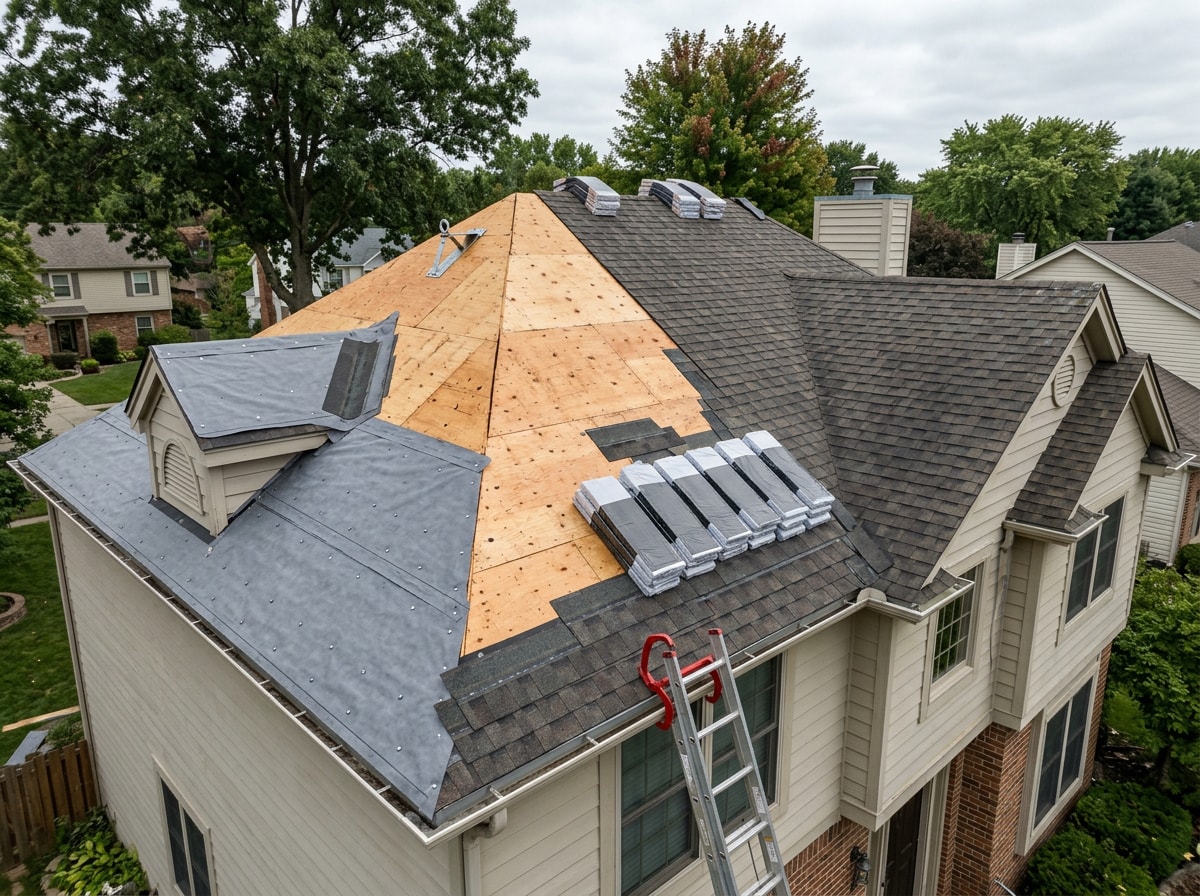
Local experience tracks with code familiarity too. A contractor who works your jurisdiction every week knows which underlayment your inspector expects, how deck nailing gets checked, and what wind ratings make sense for your exposure.
Check the address on a map. Then confirm the company actually works your area, whether that is Fredericksburg, Stafford, Spotsylvania, Culpeper, King George, Manassas, Dale City, or Bowling Green.
If you want the field-level version of this step, our guide on how to find roofing crews you can count on covers what separates an in-house crew from rotating labor.
Compare Estimates Side by Side
Most homeowners do not lose money by picking badly. They lose it by comparing bids that describe different jobs.
Three things fix that: knowing what a real estimate contains, gathering enough of them, and understanding why the lowest number carries the most risk.
What a Roofing Estimate Should Include
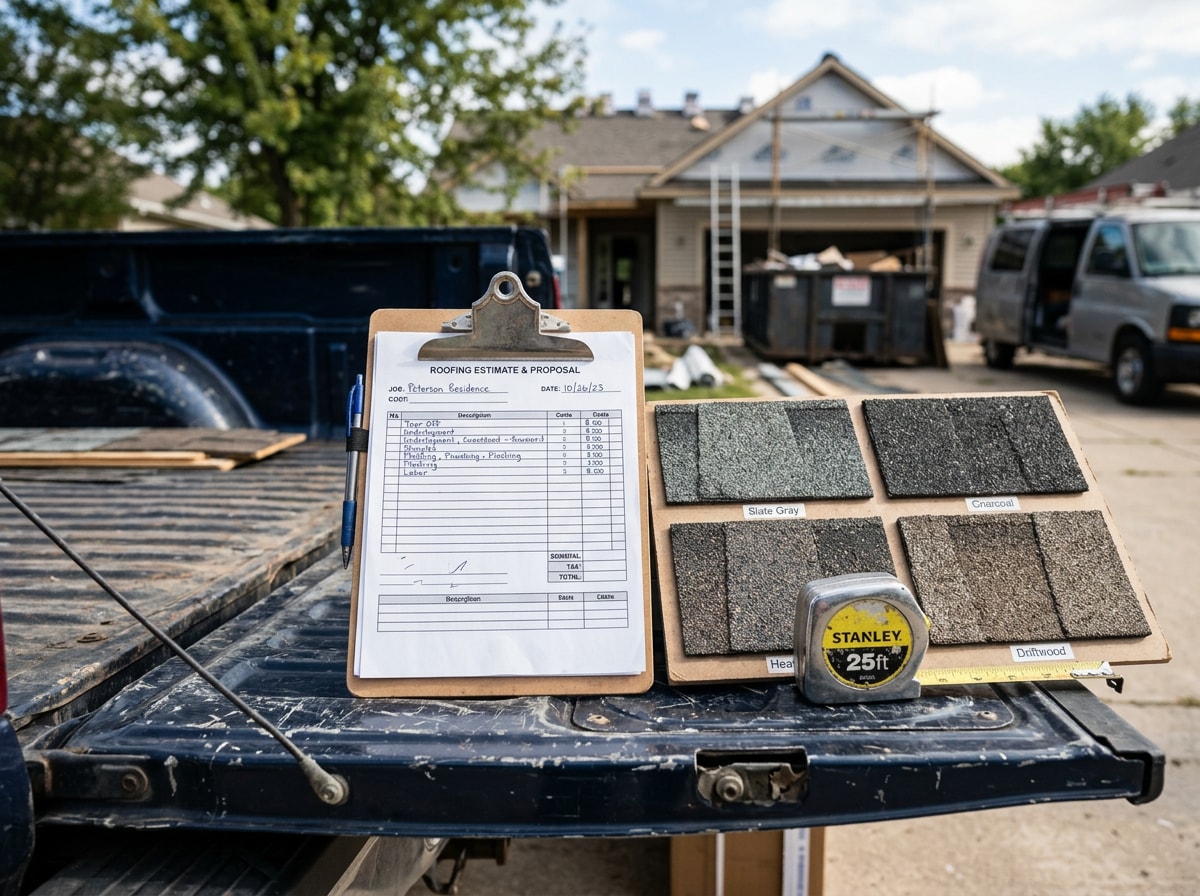
A complete estimate spells out scope line by line. At minimum it shows tear-off and disposal, decking repair terms, underlayment and ice-and-water shield, materials by brand and product line, flashing, ventilation and ridge caps, labor, warranty terms, and permit fees.
If a bid arrives as one lump sum, ask for a breakdown. Vague bids leave room for substitutions, and they make an honest itemized bid look expensive when it is not.
Print this and fill it in as each bid comes back:
| Line item | Bid A | Bid B | Bid C |
|---|---|---|---|
| Tear-off and debris disposal | |||
| Decking inspection plus repair rate per sheet | |||
| Underlayment type and ice/water shield coverage | |||
| Shingle brand, product line, color | |||
| New flashing (vs. reuse) at walls, chimney, valleys | |||
| Ventilation and ridge cap | |||
| Labor | |||
| Workmanship warranty term | |||
| Permit and inspection fees | |||
| Cleanup and magnetic nail sweep |
Get Three Itemized Written Estimates
Three is the working minimum. Two leaves you guessing about which one is the outlier. Four or more usually stalls the decision without adding new information.
Sequencing matters as much as quantity. Gathering quotes first and checking credentials later reverses the risk, because the cheapest unverified bid starts to look reasonable. Vet first, compare second.
The Cheapest-Quote Trap, and What We Actually Find on Tear-Offs
Low bids do not get low by magic. They get low mechanically, by removing things you will not notice until the roof leaks.
The usual levers:
- Thinner or substitute underlayment
- Reusing old step and counter flashing instead of replacing it
- Skipping ice-and-water shield at the eaves
- Excluding decking repair from the base price
That last one causes the most arguments. Here is the part most bids leave out: on the older homes we tear off around Fredericksburg and Stafford, soft or delaminated sheathing shows up most often in the same three places, which are the valleys, the low side of chimney flashing, and the first course above the eave. It is rarely the whole deck. It is usually a sheet or two, and it is entirely predictable.
So a bid with no per-sheet decking rate is not cheaper. It is incomplete. Ask for the rate in writing before the first shingle comes off, and the change order stops being a surprise.
Add the hidden items back and the cheapest quote often finishes above the middle bid. If the numbers still feel far apart, walk both bids through a roof replacement conversation with a contractor who will explain the difference line by line, or get a free estimate and compare it against what you already have.
Roof Warranties: Two Documents, Two Failure Modes
A manufacturer warranty covers defective materials. A workmanship warranty covers the contractor's installation. Installation error, not material defect, causes most leaks on a new roof.
Confirm four things in writing: what the workmanship warranty covers, how long it lasts, what voids it, and whether it transfers to a new owner.
| Manufacturer (product) warranty | Contractor workmanship warranty | Certified-installer system warranty | |
|---|---|---|---|
| Covers | Defective shingles or components | Installation errors and related leaks | Materials plus labor as a system |
| Typical term | Often long-term or "lifetime," with prorated periods | Commonly a few years, varies widely | Extended term, tier dependent |
| Who handles the claim | The manufacturer | The contractor who did the work | The manufacturer, backed by the certified installer |
| Transferable? | Usually once, often with a fee and deadline | Sometimes, only if stated in writing | Usually, under stated conditions |
| Commonly voided by | Improper installation, poor ventilation | Third-party work on the roof, unpaid balance | Non-certified labor, unapproved accessories |
Treat every term above as typical rather than guaranteed. Lengths and conditions vary by manufacturer, product line, and contractor. Ask for the certificate before work starts, not after.
Permits, Code Compliance, and Inspections
The contractor should pull the roofing permit in their own name and show the fee as a pass-through on the estimate.
If a contractor asks you to pull the permit, that shifts owner-builder liability onto you. It also usually signals a licensing problem. Treat it as a red flag.
Unpermitted work creates real exposure later. It can complicate an insurance claim, surface during an appraisal or title review, and force repairs or re-inspection at your cost when you sell.
Expect two inspections on a typical replacement: a deck inspection after tear-off and a final inspection once the roof is on. Most jurisdictions adopt a version of the International Residential Code, which governs building requirements for one- and two-family dwellings including roof covering, underlayment, and fastening. Many local building departments let you confirm the permit result online by address.
Red Flags That Should End the Conversation
Paperwork can be in order while the sales behavior tells you exactly how the project will go.
Storm-Chaser Door Knocks
The pattern is easy to spot once you know it. A rep knocks days after a hailstorm, offers a free inspection, climbs up alone, comes down reporting major damage, and offers to run your insurance claim.
Storm chasers move from disaster to disaster, collect deposits, subcontract the labor, and leave. The immediate risk is the deposit. The longer risk is the warranty, because there is no local company left to honor it when a seam leaks two winters later.
Get your own roof inspection from a contractor with a permanent address nearby, and handle genuine storm damage through emergency roof repair rather than a door-knock contract.
Vague Proposals and Pressure Tactics
A one-line bid reading "Replace roof, $14,500" is the most common red flag in roofing. It commits the contractor to nothing, so materials can be substituted, flashing can be reused, and anything unexpected becomes an upcharge.
Pressure tactics travel with vagueness. Today-only pricing. A discount that disappears if you get another quote. A contract pushed at you on the first visit.
A roofing contract should be specific, readable, and available to take to your kitchen table overnight. If it is not, walk away.
Large Upfront Deposits
Industry norm is a deposit of roughly 10 to 30 percent, progress payments tied to milestones such as material delivery and tear-off, and the balance at final inspection.
If a contractor wants more than half the contract before any work begins, treat it as a warning sign. Materials do not require that much cash up front. Deposit caps are set by state statute in some places and not others, so check your state's rules rather than assuming a number is illegal.
10 Questions to Ask a Roofing Contractor
Bring this to every estimate appointment. The answers matter less than how readily they come.
- What is your state license number and class? A good answer is the number itself, offered without hesitation.
- Can I see your liability and workers' comp certificates? Expect copies plus the agent's contact details.
- Who does the work, your crew or subcontractors? Either can be fine. Evasion is not.
- Who supervises the job on site each day? A name and a phone number.
- Who pulls the permit? It should be them, in their name.
- Which products are you proposing, and are you certified for them? Brand, product line, verifiable tier.
- What does your workmanship warranty cover, for how long, and does it transfer? In writing, in the contract.
- What is the deposit and payment schedule? Compare against the benchmarks above.
- How do you handle decking repair if you find rot? A per-sheet rate stated before work starts.
- What does cleanup include? Debris removal and a magnetic nail sweep, same day.
A contractor worth hiring answers all ten without flinching. The team at Shark Construction expects these questions, whether the job is a full replacement or a targeted roof repair.
FAQ
How do I know if a roofing contractor is reputable?
Confirm four things independently: an active state license, current liability and workers' comp certificates, manufacturer certification verified on the manufacturer's site, and references from local jobs finished in the past year. Website claims do not count until you check them.
How many roofing estimates should I get?
Three itemized written estimates. Three gives you enough range to spot an outlier and compare materials, warranties, and installation methods instead of judging one number with no context.
What certifications should a roofing contractor have?
The common top tiers are GAF Master Elite and Owens Corning Platinum Preferred, both of which require documented licensing, insurance, and training that is reviewed annually. Verify status on the manufacturer's contractor locator, not on a logo in a website footer.
Who is the best roofing company in the country?
There is no national winner, because roofing is installed by local crews under local code and local inspection. National brands and franchises operate through regional offices, so the quality you get still depends on the crew assigned to your address.
How long does a roof replacement take?
One to three days for a standard asphalt shingle roof on an average home. Steep pitches, complex rooflines, bad weather, or specialty materials such as tile or metal can stretch that considerably.
What time of year is best to replace a roof?
Late spring through early fall is easiest in Virginia, because shingles seal faster in warm weather and schedules are predictable. Roofs can be replaced in winter with proper hand-sealing, and off-season scheduling is sometimes quicker.
Should I pay a roofer upfront?
A partial deposit is normal. Paying the full amount before work starts is not, and it removes your only leverage if the crew never returns. Tie payments to milestones and hold the final payment until after the inspection.
Does a new roof need a permit?
In most jurisdictions, yes, and the contractor should pull it in their name. Skipping the permit can complicate insurance claims and resale later.
What should I do while I wait for estimates?
Document everything. Photograph interior stains, take dated photos of any debris in the yard, and note when leaks appear. If water is actively entering the house, call for emergency service first and sort out the full replacement decision after the roof is dried in. You can request a free estimate and have the inspection results in hand before you compare bids.
Written by the Shark Construction LLC field team, a licensed and insured roofing, siding, window, and deck contractor based in Fredericksburg, Virginia. Questions about a bid you already have? Send it to us through our contact page and we will walk you through the line items.