Roofing is a good career if you want above-average pay without tuition debt, learn by doing, and can handle heat, height, and heavy lifting. It pays from week one and rewards skill fast, but it carries the highest fatality rate of any construction trade. Here is the honest math on both sides.
Is Roofing a Good Career? The Short Answer
Yes, for the right person. Roofing pays more than the national median wage, requires no degree, and has a steady replacement cycle behind it. It also wears on your body and puts you six to forty feet off the ground most days.
Three things decide it for you:
- Entry cost is zero. You get paid while you train instead of borrowing for school.
- Income scales with skill. A ten-year metal and commercial roofer and a first-year helper live in different financial worlds.
- The physical and safety cost is real. It is not a footnote, and it does not go away with experience.
If you have chronic knee or back problems, cannot tolerate heat, or freeze up at height, roofing will frustrate you no matter how good the pay looks on paper. On our crews around Fredericksburg, VA, the people who quit almost always quit in the first two weeks of July, not in year three.
Roofer Pay in 2026: What You Actually Earn
Start with the federal numbers, not job-board averages. Per the <a href="https://www.bls.gov/ooh/construction-and-extraction/roofers.htm">Bureau of Labor Statistics Occupational Outlook Handbook for roofers</a>, the median pay for roofers is $55,440 a year, about $26.65 an hour, with the 90th percentile at $81,720 . The middle half of roofers earn between $22.24 and $31.44 an hour, or roughly $46,260 to $65,390 a year.
One detail most pay articles skip: those payroll figures exclude self-employed contractors, who make up about 20% of the trade's roughly 166,900 jobs . The owner-operators are not in the median at all, which is part of why the ceiling looks lower than it is.

| Level | Typical pay band | Years to reach | Skill that unlocks the jump |
|---|---|---|---|
| Helper / laborer | $17 to $22/hr | Day one | Reliability, ladder and safety basics |
| Installer | $22 to $28/hr | 1 to 2 years | Clean shingle courses, flashing, speed |
| Journeyman | $28 to $36/hr | 3 to 5 years | Full system knowledge, complex details |
| Foreman | $34 to $45/hr | 5 to 8 years | Crew leadership, scheduling, QC |
| Estimator / owner | $65k to $130k+ | 8+ years | Accurate takeoffs, sales, business sense |
Those bands are market estimates, not guarantees. The three levers that actually move your number are experience, specialization (metal, slate, tile, and commercial membrane all pay premiums), and geography.
There is also a clear next rung above the tools. The jump from the roofer median of $26.65 to the construction-supervisor median of $38.42 an hour is $11.77, the largest single step on the BLS ladder.
Much of the above-median money comes from how roofers get paid. Many residential crews run piece rate, a set dollar amount per square installed, so a fast and accurate crew finishes two jobs in the time a slow crew finishes one. Add production bonuses and 50 to 60 hour weeks from May through September, and efficient installers routinely clear the published median.
Roofing Job Outlook and Demand
Demand here is not driven by new construction. Roughly 80 percent of roofing work now comes from repairs and replacements on aging buildings. Asphalt shingles age out on a 20 to 30 year cycle whether the economy is booming or not, which is why roof replacement and roof repair work keeps crews booked through slow housing markets.
The federal projection backs that up. BLS projects roofer employment to grow about 5.9% through 2034, with roughly 12,700 openings a year.
The bigger story is who is left to do the work. NRCA puts the broader US roofing workforce at more than 250,000 in 2024, with 85 percent of contractors reporting they struggle to hire skilled labor.
An AGC and NCCER workforce survey found 92 percent of hiring construction companies have difficulty finding qualified workers.
Translation for a job seeker: if you show up sober, on time, and willing, you will get hired. The scarcity is leverage, and it is the single strongest argument for the trade right now.
The Honest Downsides
Roofing Pays Well, But Not for the Risk
This is the comparison almost nobody running a recruiting blog will show you. Roofer pay sits near the national median while the risk does not sit anywhere near normal.
| Metric | Roofers | All U.S. workers |
|---|---|---|
| Median annual wage | $55,440 (May 2025) | $50,980 (May 2025) |
| Fatal injury rate per 100,000 FTE | 51.8 (2023) | 3.5 (2023) |
Roofers earn a median 9% above the US median across all occupations , but the roofer fatality rate of 51.8 deaths per 100,000 full-time-equivalent workers in 2023 was the highest of any construction trade and 14.8 times the rate for all U.S. workers . Run it as pay per unit of risk and the gap is stark: roofing returns about $984 of median annual wage per fatality-rate point, the lowest of five major trades and roughly one-eleventh of plumbing's $10,857 .
That does not make roofing a bad career. It makes safety discipline a pay-grade issue, not a paperwork issue. In 2023 there were 134 roofing-industry deaths, 82 percent of them from falls, slips, or trips , and falls are the category fall protection is specifically designed to stop.
Physical Demands
A bundle of shingles runs 60 to 80 pounds, and a single roof can need a hundred of them. You carry them up ladders, walk steep pitches, and kneel for hours on a deck that bakes under summer sun. Knees, shoulders, and backs accumulate wear that shows up in your forties.

<a href="https://www.osha.gov/fall-protection/construction">OSHA's construction fall protection rules</a> exist for exactly this reason. Workers on a low-slope roof with an unprotected edge six feet or more above a lower level must be protected by guardrails, safety nets, or personal fall arrest systems. Harnesses, anchors, training, and hydration protocols cut the danger substantially. Managed risk is still risk.
Seasonal Workflow
Advertised hourly rates assume you work all year. In northern markets, you often do not. Spring and summer are packed, late fall slows, and deep winter can stall tear-offs when temperatures drop below shingle-sealing thresholds.
Experienced roofers plan around the gap. They chase repair calls, pick up commercial or interior work, follow storm markets, or budget summer overtime across twelve months instead of four.
Running a Crew Is a Second Job
Ownership means doing office work after the roof work ends. Hiring and keeping reliable people is the hardest part, and turnover is high industry-wide. Then come warranty callbacks, insurance claims, and estimating accurately enough that one bad bid does not erase a month of profit.
Add general liability and workers' comp premiums, licensing, bonding, disposal fees, and cash flow that swings hard with the season. Workers' comp rates alone vary widely, and two roofers in the same state can pay very different rates.
What a Roofer Actually Does
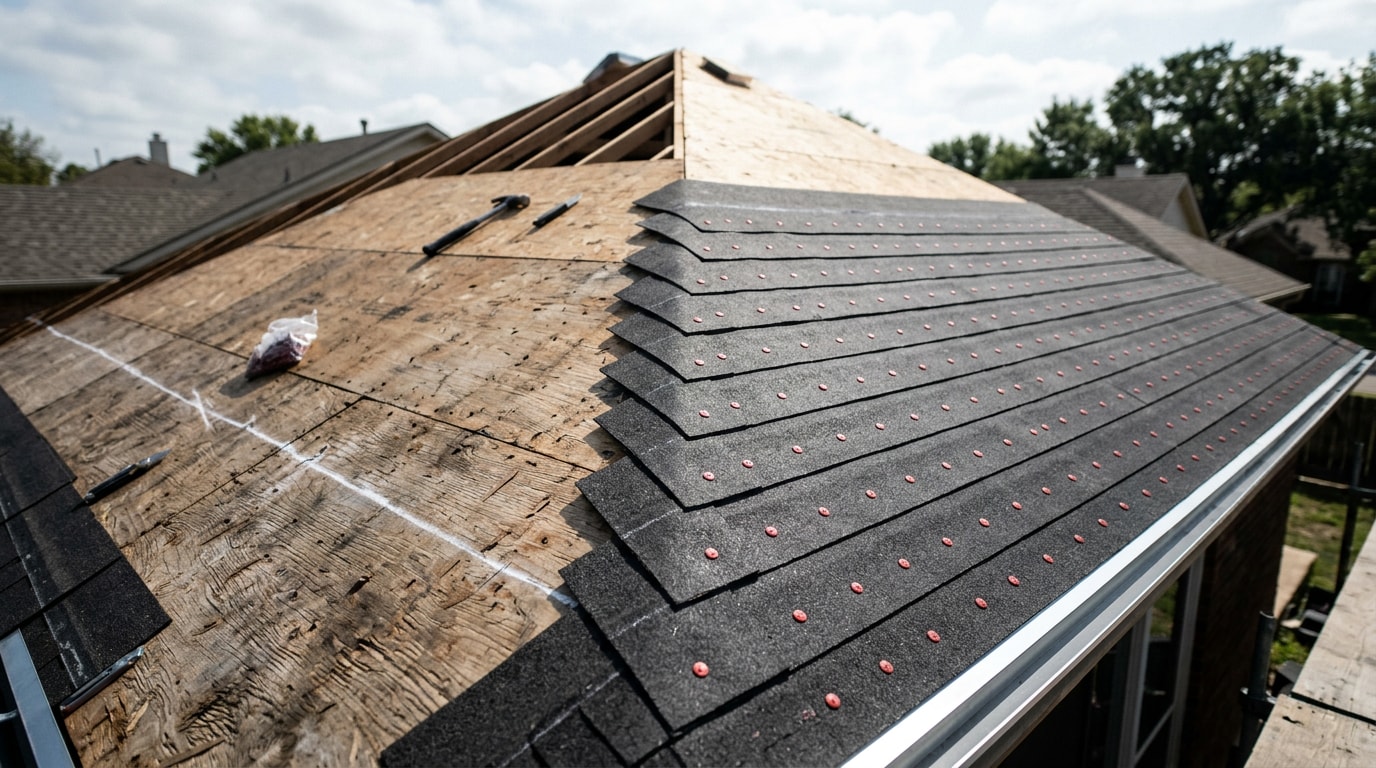
A typical day starts early, often on site by 6 or 7 a.m. to beat afternoon heat. The crew loads materials, sets ladders and fall protection, then begins tear-off, stripping old shingles or membrane down to the deck.
Next comes deck inspection and repair, underlayment and flashing, then the new system itself. Cleanup, magnet sweeps for nails, and a walkthrough close out the job.

Work varies by sector:
- Residential: steep pitches, fast pace, most jobs done in one or two days.
- Commercial: low-slope decks, TPO or EPDM membrane, torch-down or adhesives, longer timelines and bigger budgets.
Roles stack in a clear order. Laborers haul and clean. Installers set courses, cut valleys, and detail penetrations. Foremen run the crew and own quality. Estimators measure, price, and sell. Most people start at the bottom and climb. You can see the full range of work on our roofing contractor services page and in our completed projects.
If the label itself is part of what you are weighing, our breakdown of whether roofing counts as a blue collar job covers how the classification affects pay perception and hiring.
How to Start a Roofing Career With No Experience
- Apply as a helper or laborer. Most contractors hire entry-level and train on the job. No resume gap matters if you can carry bundles and follow instructions.
- Get OSHA 10 early. It costs little, signals you take safety seriously, and some employers require it before you set foot on a roof.
- Learn one system well, then a second. Asphalt first, then metal or membrane. Specialization is where the pay jumps live.
- Consider a registered apprenticeship. Programs listed through <a href="https://www.apprenticeship.gov/">apprenticeship.gov</a> pair paid work with classroom hours over two to three years.
- Track your hours and details. Photograph your own valley cuts, flashing, and penetrations. That portfolio is what gets you foreman work.
- Decide on ownership by year five. Licensing, insurance, and bonding requirements vary by state and municipality, so check your local rules before you buy a truck.
Hiring in Virginia? Contact our team and tell us what you have worked on.
If you landed here as a homeowner instead of a future roofer, get a free estimate and we will walk your roof before quoting anything. You can also start at our homepage to see the full service area.
FAQ
Is roofing a hard job?
Yes. It is one of the most physically demanding trades in construction, combining climbing, heavy lifting, height, and full sun exposure. It also carries the highest fatality rate of any construction trade, which makes consistent safety practice non-negotiable.
Do you need a degree or experience to start roofing?
No. BLS lists no formal educational credential as the entry-level education for roofers. Most roofers learn entirely on the job as helpers. A registered apprenticeship is the structured alternative.
How much can you make as a roofer?
The median is $55,440 a year, with the 90th percentile at $81,720. Helpers typically start at $17 to $22 an hour. Six figures generally requires ownership, commercial specialization, or an estimating and sales role rather than tool time alone.
Is roofing a dying trade?
No. Employment is projected to grow about 5.9% through 2034 with roughly 12,700 openings a year , and demand is tied to a replacement cycle rather than new construction. Automation has made almost no dent in tear-off and detail work.
How long does it take to become a roofer?
You can be productive on a crew within weeks. Installer-level pay usually takes one to two years, journeyman skill three to five, and foreman five to eight.
Does roofing ruin your body?
It can, if you work carelessly. Knee pads, proper lifting, hydration, and getting off piece-rate sprints as you age are what separate roofers still working at 55 from the ones who leave at 40. Many move into estimating, inspection, or ownership before the wear compounds.
Is commercial roofing better than residential?
Commercial generally pays a few dollars per hour more at the same experience level, with steadier schedules and larger budgets. Residential moves faster, rewards piece-rate speed, and is easier to enter with no experience.
What are the biggest disadvantages of being a roofer?
Fall and heat risk, cumulative joint wear, seasonal income gaps in cold climates, and an injury rate well above the construction average. None are dealbreakers on their own, and all of them are knowable before you start.
Bottom Line
Roofing fits people with stamina, reliability, patience for detail work, and genuine comfort at height. If you show up on time and learn fast, the path moves quicker than almost any other trade route: installer in two years, foreman in six, owner by your thirties if you want it.
Look elsewhere if you have chronic back or knee issues, cannot handle heat, dislike heights, or need a fixed indoor schedule. That is not weakness, just a bad match.
Still interested? Spend one full day on a roof with a working crew before you commit. Nothing else answers the question as honestly.