Knowing how to cut plastic corrugated roofing comes down to three things: the right blade, a panel that cannot flex, and a feed rate that does not cook the kerf. Get any one wrong and the sheet chips, star-cracks, or welds itself back together behind the blade. Below is the working method for PVC and polycarbonate panels, including the manufacturer rules that most DIY guides leave out.
Best Tool for Cutting Plastic Corrugated Roofing
Match the tool to two things: the cut shape and the panel thickness.
| Cut you need | Best tool | Blade or bit | Main failure mode |
|---|---|---|---|
| Long straight rip or crosscut | Circular saw (bench or portable) | Fine-tooth carbide panel blade | Blade wandering, melted kerf |
| Thin, flexible PVC, one or two cuts | Utility knife, score and snap | Fresh straight blade | Blade skipping out of the groove |
| Curves and short irregular lines | Jigsaw, orbital action off | Fine-tooth metal blade | Vibration cracking at the ribs |
| Small notches around posts and pipes | Tin snips or metal shears | n/a | Wavy, distorted edge over long runs |
| In-place trims, tight spots | Oscillating multi-tool | Fine bi-metal blade | Slow, rough kerf |
| Edge tidying, detail work | Rotary tool | Carbide or plastic bit | Melting the cut face |
Panel makers back this split. Palram's Suntuf guide calls a bench or table circular saw best for long straight cuts, says panels should be clamped during sawing to avoid vibration, limits jigsaws to short irregular or curved lines, and keeps hand saws, shears and knives for localized work.
Westman Steel's PVC and polycarbonate guide says the same for a circular saw at high speed with a low advance rate, and points you to a jigsaw or metal shears for curves.
Not sure which panel is on your frame? Our breakdown of what polycarbonate roofing actually is covers the common profiles and how they differ from PVC.
How to Cut Plastic Corrugated Roofing with a Circular Saw
This is the method for anything thicker than a flexible PVC sheet, and for any job with more than a couple of panels.
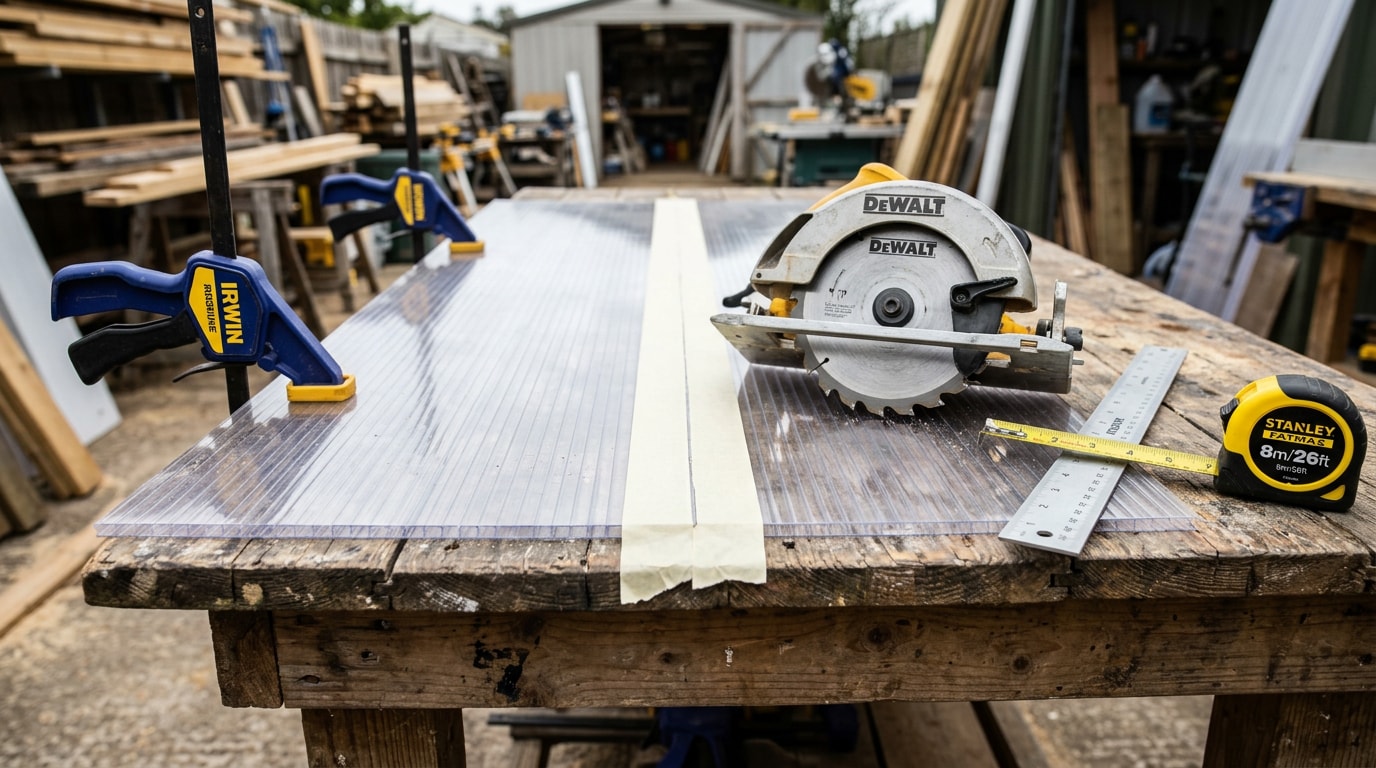
- Fit the blade first. Swapping blades later smudges your marked line and costs you the setup.
- Leave the factory film on. It protects the surface and takes your marker line.
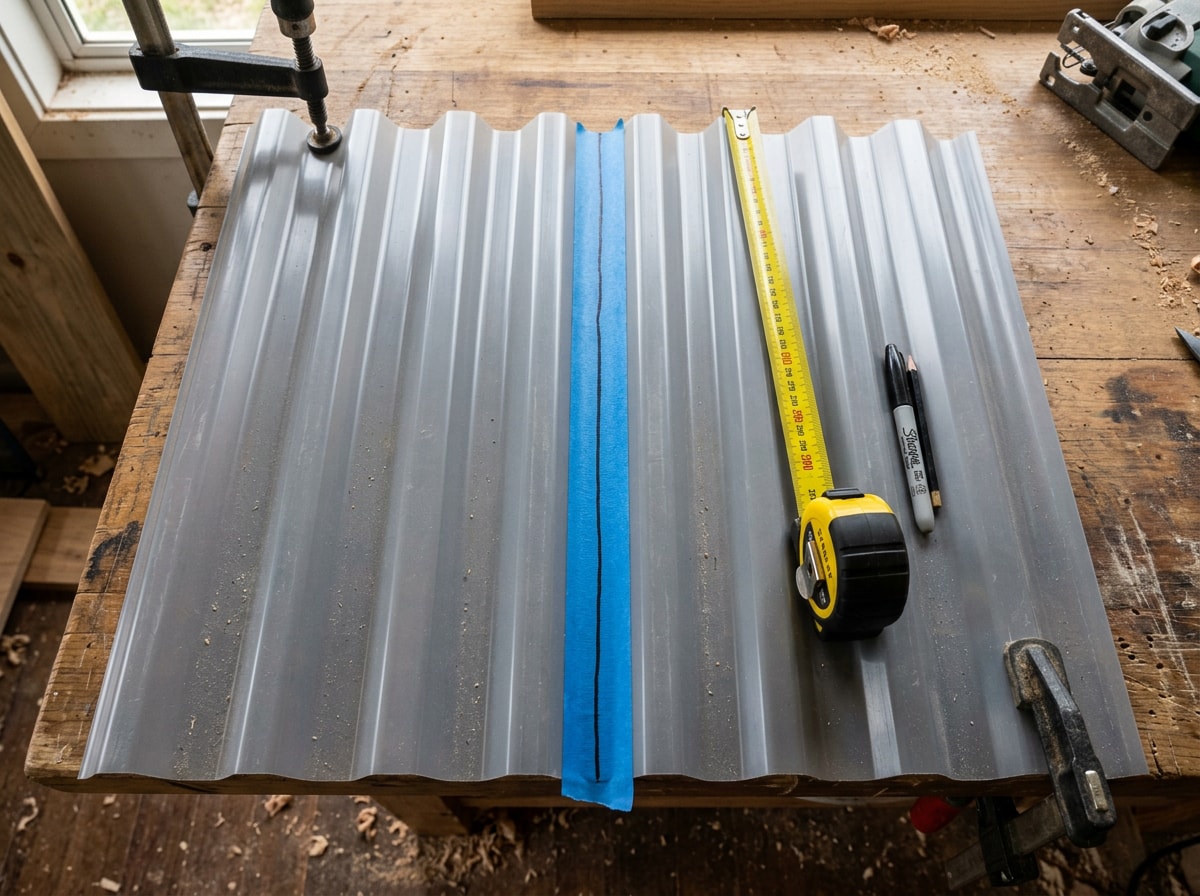
- Mark on the flat troughs, not the ridge crowns, then join the marks with a straight edge.
- Run masking tape along the line. It holds the cut face together as the teeth exit.
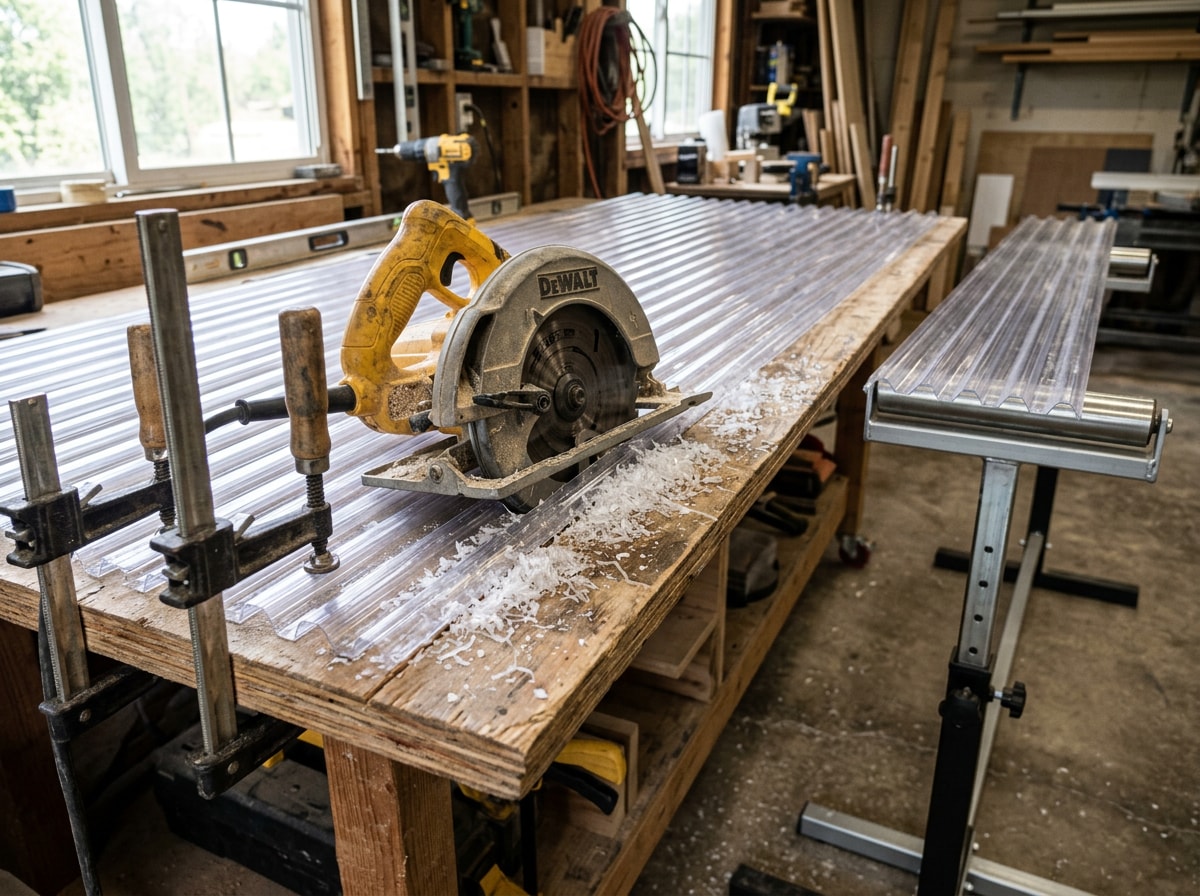
- Clamp the panel to the bench on both sides of the line, close to the kerf, not just at the corners.
- Set the cut so the waste hangs about an inch past the bench edge and clears the blade at full depth.
- Start the saw at full speed before the teeth touch plastic, then feed slowly and steadily to the far end.
- Support any off-cut longer than about three feet. Unsupported plastic snaps as the kerf closes behind the blade.
- Blow or vacuum the chips off the sheet before it goes on the roof.
Westman Steel calls for removing dust with compressed air or a vacuum before installation.
- Ease the cut edge with emery cloth, then peel the film back only at the cut.
Two production tricks that almost never appear in DIY write-ups:
- Stack your panels.
Westman Steel's guide has you cut three to four sheets at a time with a fine-tooth blade at high speed and low advance rate. The stack damps vibration and your panels come out identical.
- Run the blade backwards.
Palram specifies cutting with blades mounted in reverse direction, spinning at high speeds, with material fed at a slow rate. A reversed fine-tooth blade scrapes rather than bites, which is what keeps the edge from chipping.
How to Cut Thin Panels by Hand: Score and Snap
Score and snap belongs to thin, flexible PVC profiles and one-off cuts. It is not a method for a full roof.
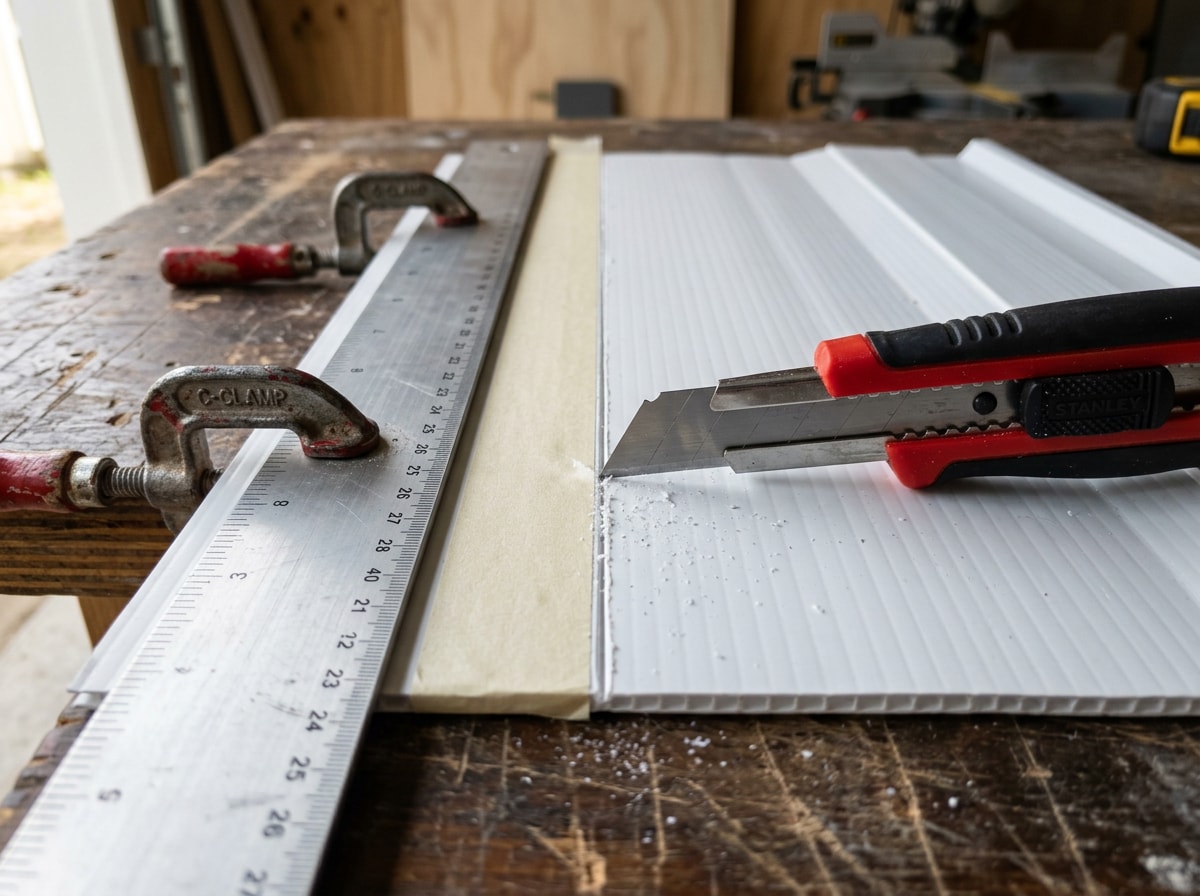
- Mark the line on a flat section and tape over it.
- Clamp a straight edge along the line so the blade cannot drift.
- Score five or six light passes. Light repeat passes beat one deep gouge every time.
- Move the score line to the bench edge, re-clamp, then press the waste down with even pressure.
- Deburr the edge with emery cloth or a light pass of a fresh blade.
The honest caveat: a knife can ride up out of the groove on deep-ribbed or rigid panels, which is both a ruined sheet and a hand injury waiting to happen. Manufacturer guidance allows utility knives, but also insists sheets be clamped for hand-saw cutting to prevent vibration. Thin and flexible means knife. Thick or deep-ribbed means saw.
Cutting Curves, Notches, and Holes
Guides disagree about jigsaws because both answers are right in different setups. The blade's up-and-down stroke shakes an unsupported sheet hard enough to crack the ribs. Clamped tight on both sides of the kerf, with orbital action off and a fine metal blade fitted, it cuts curves cleanly. Palram allows a jigsaw for a limited length of irregular or curved lines.
One rule saves more panels than any tool choice. Avoid intersecting cuts, and if you must make one, drill a hole at the intersection point and cut the panel up to the hole. That drilled relief hole stops the crack that otherwise runs out of a sharp inside corner.
For a notch around a post, bracket, or downspout, tin snips or metal shears beat any saw. Keep them to short runs. Over several feet, snips distort the profile and the edge goes wavy.
Prep That Stops Cracks Before the Blade Arrives
Most ruined sheets are not tool failures. They are support and marking failures that happened before anything was switched on.
- Clamp to a flat, solid surface with scrap plywood or cardboard underneath.
- Never cut on grass, gravel, or anything that lets the sheet flex.
- Clamp close to the cut line, but do not crush a ridge crown. Pressure on an unsupported crown cracks panels on a tidy-looking bench.
- Measure against the structure itself, not the old panel, before committing.
- When trimming width, cut down the center of a trough so flashing and foam closures still seat.
Temperature matters too. Plastic goes brittle in the cold and grows in the sun, so mild, dry, mid-morning conditions give the most predictable cut. Wet panels also slide under a straight edge and spoil accuracy.
Field note from our crews: on a February carport re-sheet in Fredericksburg, VA, the first panel cracked away from the kerf at about 30 degrees on the bench. We moved the remaining sheets into a heated garage overnight and cut them the next morning with zero losses, same blade, same saw. Cold sheets are the single most common reason a clean setup still produces a cracked panel.
If a panel already cracked on the roof rather than the bench, that is a water problem now, and our roof repair team can seal it before it reaches the deck. Get a free estimate and we will tell you whether a patch or a panel swap makes more sense.
Blades, Bits, and Feed Rate
- Use fine-tooth blades sold for plastics.
Carbide triple-chip fine-tooth panel blades are the specified choice for circular saws.
- Aggressive wood-framing blades tear the material instead of slicing it.
- In rotary tools, stick to carbide or plastic-specific bits.
- Feed rate decides edge quality. Too slow and friction melts the kerf. Too fast and the face chips.
- Replace a dull blade. Dull teeth generate heat, and heat is what melts polycarbonate.
Safety Gear for Cutting Plastic Panels
Three items cover the real hazards: sealed safety glasses or goggles, gloves for the fresh cut edge, and a dust mask when you are cutting in a garage or shed. Anyone steadying a long off-cut needs eye protection as well, because they are standing in the same debris path. OSHA's construction eye and face protection requirements sit in 29 CFR 1926.102, under Subpart E ; the agency's eye and face protection standards page lists what applies.
After the Cut: Fasten for Movement, Not Just for Grip
A perfect cut still leaks if the fastener holes are wrong. Plastic panels move with temperature, so the hole has to let them.
Pre-drill fastener holes larger than the screw diameter to allow for expansion and contraction , following the figure in your panel's own guide.
Over-tightening screws can distort the sheet and lead to cracks and fractures.
Palram's guidance is to keep a small gap where sheets meet another object, pay attention to length because sheets expand most along that direction, and pre-drill oversize holes so screws do not stress the sheet . Their Suntuf corrugated panel page covers the thermal movement detail.
- Check the manufacturer's lap and fastening spacing before you start.
Westman's PVC and polycarbonate installation guide sets a minimum 4 inch end lap and a side lap of one corrugation.
Planning a whole new panel roof instead of a patch? See our roof installation service, or browse recent projects for what finished work looks like.
FAQ
What is the best tool to cut plastic corrugated roofing?
A circular saw with a fine-tooth carbide panel blade, for almost every job. A bench or table saw is best for long straight cuts, and a portable circular saw handles on-site straight cuts. Reach for a knife only on thin, flexible PVC.
How do you cut corrugated plastic roofing by hand?
Use a fine-tooth hand saw with the panel clamped on both sides of the line, or score and snap thin sheets with a utility knife. Sheets must be clamped for hand-saw cutting to prevent vibration. A hand stroke is slower and less consistent than a powered blade, and that inconsistency is what chips the edge.
Can you cut corrugated plastic with a jigsaw?
Yes, within limits. Manufacturers allow a jigsaw for a limited length of irregular or curved lines , not for long straight rips. Switch orbital action off, fit a fine blade, and clamp tight on both sides of the kerf.
Can you cut corrugated plastic roofing with tin snips?
Yes, for notches and short shaped cuts around posts, brackets, and downspouts. Metal cutting shears are a recommended option for curved cutting. Snips are a poor choice over several feet because the edge goes wavy and distorted.
Can you use an angle grinder on plastic roof panels?
It is a last resort. A grinder spins fast with no tooth geometry, so it tends to melt the kerf and throw hot plastic. If a grinder is all you have, use a thin cutting disc, move quickly, and expect to dress the edge afterward.
Should you leave the protective film on while cutting?
Yes. Leave the factory film in place through cutting and installation to prevent scratching, then peel it back at the cut edge and before final exposure. Masking film should remain on the sheet to prevent scratching.
How do you cut a hole or an inside corner in a panel?
Do not run two cuts into each other. Drill a hole at the intersection point and cut the panel up to the hole. The drilled hole ends the cut with a curve instead of a stress-raising sharp corner.
Why does my panel crack even with the right blade?
Usually movement or temperature. The sheet was clamped only at the corners, the off-cut was unsupported, or the panel was cut cold. Panels should be clamped during sawing to avoid vibration. Warm the sheets and clamp near the kerf.
How do you cut corrugated plastic roofing lengthwise?
Cut down the center of a trough, never on a ridge crown, so flashing and closure strips still seat properly. Clamp a straight timber batten alongside the line as a saw fence, and support the waste side the whole way.
Work With Us
This guide reflects how our own crews cut PVC and polycarbonate panels on carports, porch covers, and skylight infills across Virginia. Shark Construction LLC is a licensed, insured roofing, siding, and window contractor serving Fredericksburg, Stafford, Spotsylvania, Culpeper, and surrounding counties. See what we do at Shark Construction LLC or browse our roofing services.
Cutting panels yourself and want a professional to check the frame, flashing, and fastener layout first? Book a roof inspection or get a free estimate.