Is roofing paper waterproof? No. It is water resistant, which is a different job with different limits, and the gap between the two explains why a brand new roof can still weep at a nail hole.
Short Answer: Roofing Paper Is Water Resistant, Not Waterproof
Roofing paper sheds water that runs across its surface.
It will not hold back standing water, and it does not seal itself around fasteners or at lapped seams.
The covering above it, shingles, tile, metal, or slate, does the primary work. Underlayment is the backup.
The Asphalt Roofing Manufacturers Association puts it plainly: asphalt-saturated organic felt is water resistant because of its asphalt content, but the organic reinforcement allows some vapor permeability and moisture absorption .
A material that absorbs moisture is not a waterproof membrane. It is a drainage plane.
Water Resistant vs. Waterproof: Where Felt Gives Way
Water resistant means the sheet repels incidental moisture for a limited stretch of time.
Waterproof means a continuous barrier that holds even under pooled water and hydrostatic pressure.
Most explainers stop at the definition. Here are the three specific places felt reliably gives way on a real roof:
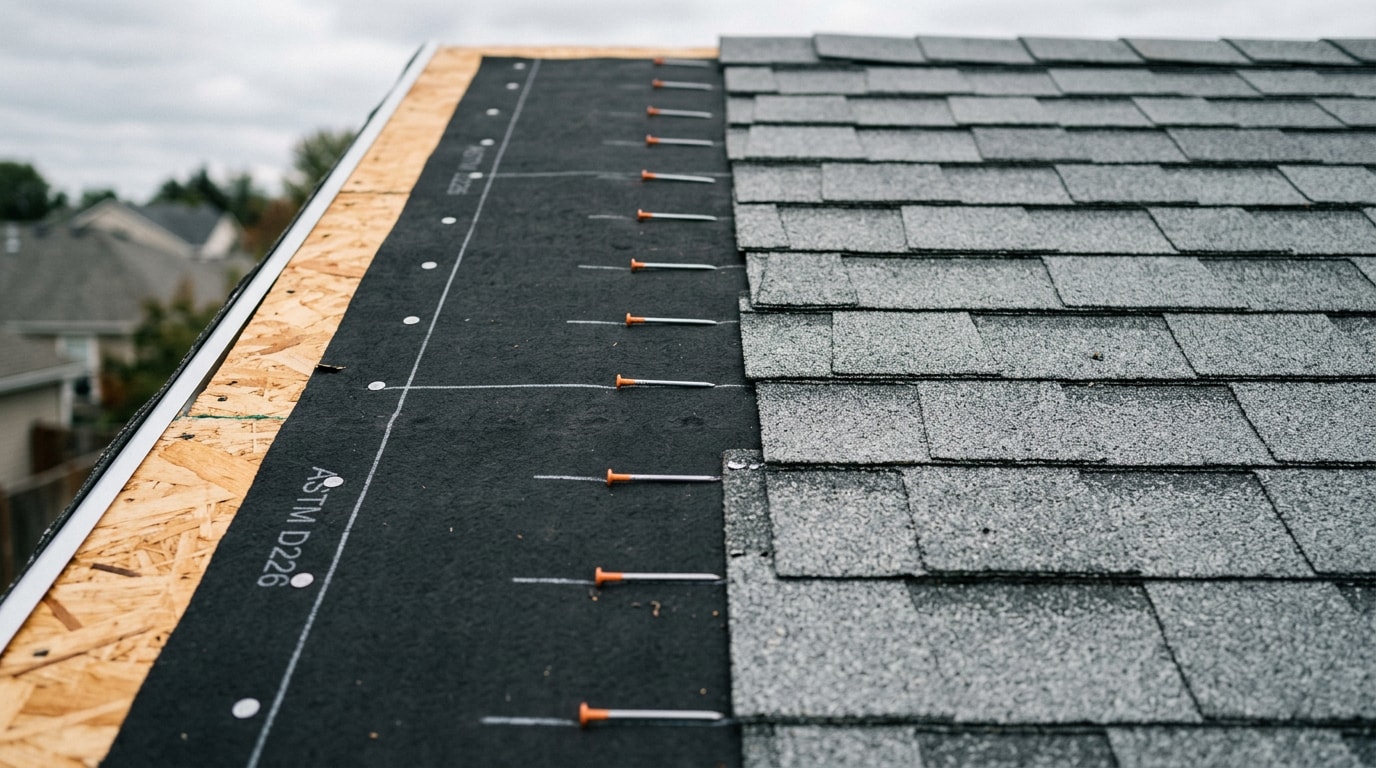
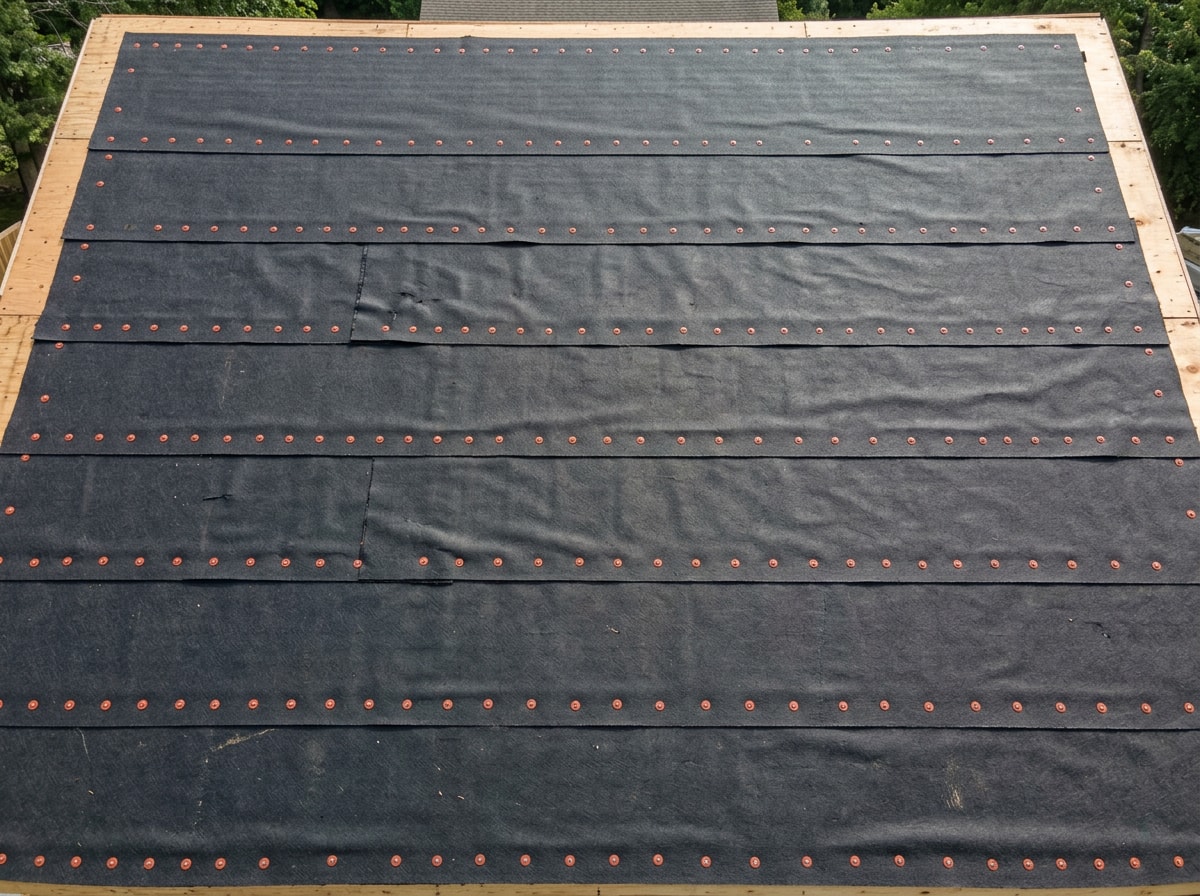
- Fastener penetrations. Every cap nail or staple is a hole. Felt does not close around the shank.
- Lapped edges. Water pushed uphill by wind can wick between layers at side and end laps.
- Low spots and ice dams. Where water sits instead of running off, felt eventually lets it through.
None of that is a defect. Building codes treat underlayment as a required component of a roof covering, not as the covering itself. The IRC roof covering requirements call for asphalt shingle underlayment meeting ASTM D226, ASTM D4869, or ASTM D6757 , always beneath a finished roofing material. You can read the underlayment provisions in Chapter 9 of the International Residential Code at ICC Digital Codes.
If you want a professional read on your own assembly, our roof inspection crew can walk the layers with you.
What Roofing Paper Is and How It Is Made
Traditional roofing felt starts as a base mat of organic wood cellulose, fiberglass, or polyester.
That mat is then saturated with asphalt, also called bitumen. The asphalt repels water while still letting the product breathe , and the mat holds the sheet together so it can be rolled, walked on, and nailed down.
The naming is messier than the product. Roofing paper, felt paper, tar paper, roofing felt, and asphalt-saturated felt all refer to the same category. Contractors use the terms interchangeably, so do not read a difference in protection into a difference in vocabulary.
One more point worth clearing up: 15-lb felt and 30-lb felt describe a weight class, roughly the original weight per 100 square feet. ASTM calls these Type I (commonly No. 15 asphalt felt) and Type II (commonly No. 30 asphalt felt) . Those are not waterproofing ratings. A 30-lb sheet is heavier and harder to tear. Neither one is sealed.
What Roofing Paper Actually Does on a Roof
The protection is real, but it is role-specific. Underlayment has two jobs: one that runs for the life of the roof, and one that only matters for a few days.
Job 1: Secondary weather barrier
Shingles form the primary water-shedding layer.
Underlayment sits below and catches the small amount of water that gets past the covering through wind-driven spray or a lifted tab, then redirects it down the slope and out at the eaves.
It does quieter work too:
- Acts as a modest vapor retarder, slowing moisture movement from the attic side.
- Separates asphalt shingles from the wood deck, where sheathing resins can react with shingle backing over time.
- Gives the roof a continuous drainage plane during shingle repairs.
Job 2: Temporary dry-in protection
During dry-in, the window between tear-off and the covering going back on, the paper is the only thing between your house and the weather.
Felt handles light to moderate rain over short periods. It does not handle wind-driven rain pushing water sideways under laps, ponding on a low slope, or ice damming at the eaves.
When felt soaks through, it swells and buckles. That wrinkling can telegraph through shingles installed over it, leaving visible ripples in a new roof.
Good dry-in starts with timing the job around the forecast, which is why our roof replacement crews plan tear-off size around the day's weather window rather than the whole roof at once.
How Long Can Underlayment Stay Exposed?
This is where the three main products actually separate, and it is the number worth checking before you buy.
| Underlayment type | Water performance | Published exposure window | Seals around nails? |
|---|---|---|---|
| Asphalt felt (15 or 30 lb) | Sheds running water, absorbs moisture |
Generally meant to be covered right away
| No | |
|---|---|
| Synthetic (woven polypropylene) | Sheds water, does not absorb or wrinkle |
Manufacturer data sheets list limits from about two months to 30 months
| No | |||
|---|---|---|---|
| Self-adhered rubberized asphalt | Watertight membrane | Varies by product, typically months | Yes, seals around nail shanks |
Real published examples show the spread: Atlas Summit 60 is listed at 60 days of UV exposure under AC 207 , CertainTeed RoofRunner is tested for UV resistance up to 90 days , and Tri-Flex XT allows up to six months before the final covering goes on .
Treat those numbers as ceilings, not schedules. An underlayment rated for six months is not a roof for six months.
The Standards Behind the Marketing Words
Adjectives like "moderate" or "premium" protection mean nothing without a spec behind them. These three standards do the actual defining.
| Standard | What it governs | What it actually means |
|---|---|---|
| ASTM D226 |
Asphalt-saturated organic felt, Type I (No. 15) and Type II (No. 30)
| Sets minimum weight, strength, and pliability. A shedding spec, not a sealing spec | |
|---|---|
| ASTM D4869 | Asphalt-saturated organic felt underlayment for steep slope roofing |
Adds a liquid-water transmission (shower) test and dimensional stability limits that D226 does not include
| ASTM D1970 | Self-adhered polymer-modified bitumen sheet |
The standard referenced for self-adhering membranes
, and the one that addresses sealing at penetrations |
That last row is the real dividing line between water resistant and watertight. You can review the published scope for the felt specification on ASTM International's D226 page.
One caveat worth your attention: some rolls are marketed as "15-lb" or "30-lb" without meeting any ASTM standard at all. Check the label for a spec number, not just a weight. The Asphalt Roofing Manufacturers Association's underlayment guidance is a good sanity check before you approve a material on a proposal.
Synthetic Underlayment and Ice and Water Shield
Synthetic underlayment is woven or spun polypropylene or polyester, often with a coated surface. The fibers repel water rather than absorb it, so the sheet does not swell, wrinkle, or tear the way saturated felt does once it gets wet.
The honest verdict: standard synthetic is more water resistant than felt, and it is still not waterproof. Water can pass at fasteners and laps on both products.
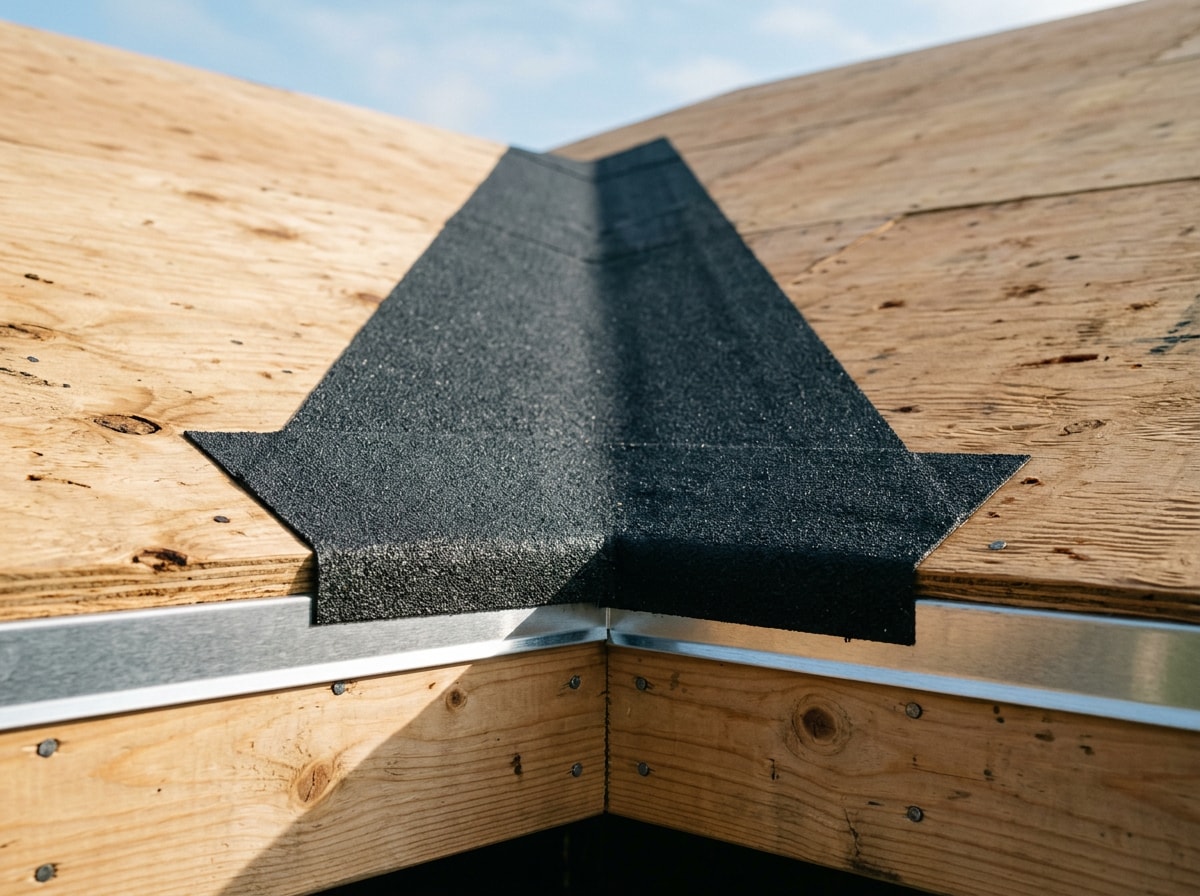
One product class genuinely seals. Self-adhered rubberized-asphalt membrane, sold as ice and water shield, bonds to the deck and closes around nail shanks. That is why codes and manufacturers concentrate it where water collects: eaves, valleys, and around chimneys and vents.
If you are weighing the whole assembly rather than one layer, our guide to what roofing material lasts the longest covers how covering choice changes what the underlayment underneath has to survive.
What To Do If Your Underlayment Got Rained On
On a finished roof, the paper is never exposed. The question only comes up in two situations: during installation, or after something above it fails.
Here is what we check on tear-offs around Fredericksburg and Stafford when felt takes a soaking overnight. The wrinkles are obvious from the driveway. The damage that matters is not: it shows up as dark staining on the sheathing at the laps, where water sat long enough to wick into the plywood.
Walk through this list before shingles go down over wet paper:
- Look for buckling or ripples. Wrinkled felt telegraphs through new shingles.
- Check for tears around staples and cap nails, especially at the rakes.
- Lift a lap and look at the deck for dark staining or soft sheathing.
- Confirm the deck is dry before anything new is fastened over it.
- Replace saturated sections rather than drying them in place.
If a storm stripped the covering and left underlayment doing work it was never designed to do alone, that is an emergency roof repair, not a wait-and-see item.
For smaller trouble spots, a targeted roof repair is usually enough. For a full tear-off, ask your roofing contractor which underlayment they are using and what its published exposure rating is before you sign.
Get a Free Estimate from Shark Construction LLC and we will tell you exactly which underlayment goes on your deck, and why. You can also see the layers on finished work through our roof installation service page or browse recent projects.
FAQ
Is roofing felt 100% waterproof?
No. Roofing felt sheds water that flows across its surface rather than sealing against it. Nail holes, lapped seams, and standing water all let moisture through, which is why felt is always installed as a backup layer under a finished covering.
Can roofing paper get wet?
Yes, briefly. Short exposure to rain is survivable. Prolonged saturation is not. Organic felt can absorb water and wrinkle or tear if left wet too long, while synthetic felt resists absorption and dries faster .
How long can roofing felt be left exposed?
Only a short time. Most asphalt felt does not carry a published exposure time because it is meant to be covered quickly, since it wrinkles when wet and degrades under UV . Synthetics publish real windows, commonly 30 days to 12 months depending on the product.
Is tar paper waterproof?
No. Tar paper and roofing paper are the same product under two names, so the answer does not change. It repels running water and protects the deck temporarily, but it cannot stop water that pools, backs up under ice, or enters at fasteners.
What happens if it rains before the shingles go on?
A short shower on properly lapped underlayment usually causes no damage. A long soaking can wrinkle felt, loosen fasteners, and stain the deck. Inspect the laps and sheathing before covering it, and replace any section that stayed saturated.
Is underlayment required by code?
Yes, for asphalt shingle roofs. The IRC requires underlayment meeting ASTM D226, ASTM D4869, or ASTM D6757 under asphalt shingles , with the exact type and number of layers tied to roof slope.
Is 15-lb or 30-lb felt better?
30-lb felt is heavier, tougher underfoot, and less prone to tearing in wind during installation. Neither weight is waterproof. If your crew needs more than a day of dry-in time, a synthetic or a self-adhered membrane is the better answer than a heavier felt.
Is synthetic underlayment worth it over felt?
Usually, yes, for two reasons: it does not wrinkle when wet, and it carries a published exposure rating. It costs more per roll. For a tear-off that may sit open through a weather delay, that exposure rating is the feature you are paying for.
Does underlayment stop leaks?
It delays and redirects them. Underlayment buys time and channels incidental water to the eaves, but a persistent leak means the covering, flashing, or a penetration has failed above it. Fix the source, not the backup layer.